
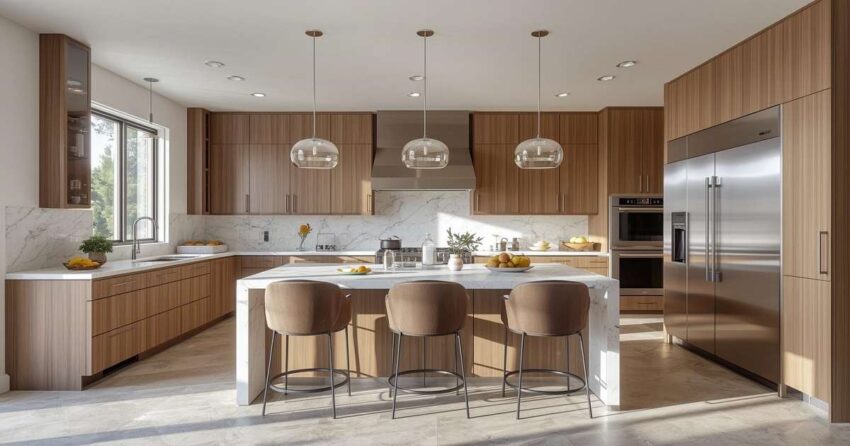
Introduction:
There were times that the kitchen was solely a utilitarian space, a backroom that was reserved for cooking, cleaning, and storage. It was a space of scents and sounds that were separated from the polished beauty of dining and living spaces with solid walls and sealed doors. The times have changed, and our lives have also changed.
The kitchen of today has been redeemed as the real central point of any home. It’s no longer merely an area to cook a meal; it’s the place where families gather to eat breakfast together, the place where guests gather at parties, and where kids do their homework while parents cook dinner. This new way of life has led to one of the longest-lasting and most popular trends in contemporary interior design:
The Modern Open Kitchen Design
At Homzinterio Homzinterio, we’ve witnessed this change firsthand. A growing number of homeowners are demolishing walls to create spacious, fluid spaces that combine the kitchen and the living space. But creating an open kitchen requires a careful blend of functionality and aesthetics. It requires a kitchen that is attractive enough to be visible all the time, but functional enough to withstand the demands of cooking.
In this article well go over all you must learn about open kitchen designs, from the undisputed advantages and popular layouts, to the practical issues of storage and ventilation.
Why Go Open? The Allure of the Open Plan
What is the reason why the concept of open kitchens has been taking the world of interior design to the forefront? The answer lies in its unique mix of practical and psychological advantages it provides.
1. The Illusion of Space
In modern, urban areas, living spaces are usually an option. Eliminating the wall that separates the kitchen from the living room immediately creates a floor plan that makes it appear larger, more airy, and more light. With no partitions hindering your vision, the eyes can travel farther and create a feeling of grandeur even in smaller homes.
2. The Social Connection
“Isolated cook “isolated cook” is a time gone by. A small open-style kitchen design facilitates interaction. If you’re hosting an evening party or having a chat with your spouse following a tiring day. An open-plan layout makes sure that the cook is not removed from conversation. The cooking becomes an enjoyable activity for everyone instead of a single task.
3. Natural Light Flow
Kitchens usually have smaller windows than living rooms. When you open up the kitchen and allow light from the windows of the balcony or living room to flow through the kitchen. A kitchen that is well-lit, not just clean, is also a much happier and more lively space for working in.
4. Higher Resale Value
Recent trends in real estate indicate that houses with open-concept layouts are a popular choice. They are viewed as contemporary flexible, accommodating to families, and family-friendly, and could boost the value of the home.
Popular Open Kitchen Layouts
The look of open kitchens is not always similar. The design you select is largely dependent on the available space and the overall shape of the room. Below are the top efficient plans suggested by interior designers:
The One-Wall Layout (Straight Kitchen)
The ideal layout for studios and small lofts, this design includes all appliances and cabinets that are arranged along one wall. It’s the ideal space-saving layout.
To make it function in the open-concept kitchen, it is usually paired with a table for dining or an island that can be used as a discreet line between the living and cooking zones.
The L-Shaped Kitchen + Island
This is probably the most sought-after arrangement for open-plan. The L-shape makes use of the corner effectively, providing plenty of counter space. If you place an island in the middle of it, it creates the focal point, creating a connecting point that connects the kitchen to the living room.
The island could be used as a counter for preparation, as well as a breakfast counter, or even a place to store an oven or sink.
The U-Shaped Layout
If you’re looking for a little bigger space in your kitchen, the U-shape can provide the most efficient workflow (the traditional “kitchen work triangle”). If you are working with an open concept, it is common for one “arm” of the U to be a peninsula, a counter that is attached to the wall at one side and is open on the other.
This peninsula can be used as a breakfast bar or serving buffet, effectively separating the dining while not hindering the view.
The Galley (Parallel) with an assthroas-through parallel kitchens are generally closed, you can alter them to open-plan by taking the upper portion of one wall, allowing for windows asl as a “passthrough” counter.
This allows you to enjoy the benefits of a parallel kitchen and the interconnectivity of an open-plan.
The Mess Factor: Dealing with Problems
While open kitchens can be beautiful, they present some issues. Since the kitchen is constantly accessible, the clutter can’t be kept behind a door. Additionally, the sound of blenders as well as the scent of tadka could be heard in rooms like the family room. This article will help you tackle these problems with a clever design.
1. The Ventilation Imperative
When it comes to Indian cuisine, which is characterized by fragrant spices and heavy fragrances, an efficient chimney is essential in a kitchen that is open to the public.
- Suction Power: Choose chimneys with large suction capacity (1200 m3/hr or greater) to ensure that smoke and odors are absorbed right away.
- Placement: Make sure the hob is not in the direct airflow of your AC or living room fan to stop odors from propagating.
2. Hiding the Clutter
Because your kitchen counters are on the show, your storage options must be perfect.
- Appliance Garages: Design an appliance garage with shutters that conceal appliances on the countertop, such as toasters, mixers, and coffee machines, when they are not being used.
- Deep Drawers: Make use of a deep, tandem kitchen cabinet to maximize storage space and pans, so that they don’t get put in the kitchen.
- The Dity Kitchen: In the luxury villas, a style is emerging in which a small closed “we’ kitchen” is used for cooking and heavy washing, and the more pristine “dry kitchen” (open plan) is utilized for plating and preparation.
3. Noise Control
Open plans amplify sound. To reduce this
- Consider investing in quiet equipment (dishwashers as well as washing machines that have very low decibels).
- Use soft-close hinges on drawers and hinges to avoid banging noises.
- Use soft furniture (rugs or curtains and couches with cushions) in the living space to block out the sound.
Designing for Cohesion: Blending Two Worlds
The most common mistake that homeowners make when it comes to open kitchens is that they treat them as separate from the living area. To make an open-plan succeed th, there has to be a visual continuity.
Color Palette Coordination
The kitchen cabinets don’t have to match the furniture of the living space; however, they must complement the furniture. If your living space is decorated with warm tones of beige, a bright neon green kitchen is likely to be a clash.
- Harmonious Tones: Use an unfussy base (white, gray tones) for your kitchen. You can also bring in pops of color to complement the sofa cushions or artwork. Thee of the same flooring throughout the living and kitchen areas makes a seamless flow cr, creating a huge space. If you prefer distinct areas, you can use complementary elements that move seamlessly.
Lighting Layers
The lighting in an open kitchen serves two functions: practical and ambience.
- Task Lighting: The lights in the under-cabinet are crucial for illuminating the countertop where you cook and chop.
- Ambient Lighting: Recessed ceiling lighting gives general lighting.
- Statement Lighting: The moment to become imaginative. Three pendant lights that hang above the counter for breakfast or kitchen island function in the role of “jewelry” for the room t, that draw the eye and draw attention to the area.
Material Consistency
If you are using walnut wood for the finish of your TV, think about applying the same finish to the kitchen islands or shelves. The repetition of the materials ties spaces together, making the appearance more professional and luxurious.
The Semi-Open Compromise
Are you swayed by the appeal of an open-plan kitchen as well as the privacy and security of an enclosed kitchen? It might be worth considering semi-open designs.
This combination approach offers the most beneficial combination of the two.
- Glass Partitions: Set up floor-to-ceiling windows that open to the ceiling. The glass will keep the visual connection and the light flow ho; however, you can also close the doors during cooking to reduce sound and smell.
- A raised breakfast counter: Make the counter that faces the living area lower (about six to eight inches) than the worktop. The raised bar conceals the messy dishes that are in the sink, or the cutting boards that are on one counter, thereby blocking people seated at the table.
The Homzinterio Advantage
Homzinterio is a place where you can relax and enjoy your time. Homzinterio we, recognize that the kitchen is an individual space. What is suitable for four people who enjoy might not be the best choice for a couple who cook stir-fries.
If you select us to do your open kitchen remodeling, wey attention to:
- Custom Ergonomics: We determine the counter-heights of your work triangles as well as other angles based upon your use.
- 3D visualisation: We can provide real-life 3D renders to visualize exactly how your kitchen will blend with your living space before even laying a brick.
- Smart Storage: From magical corners to a pull-out pantry, we make the most of all the space we can to make sure that your kitchen is clutter-free.
Conclusion
The open kitchen isn’t an aesthetic trend; it’s an expression of a modern, open, welcoming lifestyle. It encourages interaction, celebrates spaces, and turns cooking into a joy shared by all. Although it is a process that requires careful planning of storage and ventilation bu, the result is a house that is more spacious, brighter, and infinitely more inviting.